
Mahatma Gandhi International School Trains 47 AMC Teachers in collaboration with Tata Trust
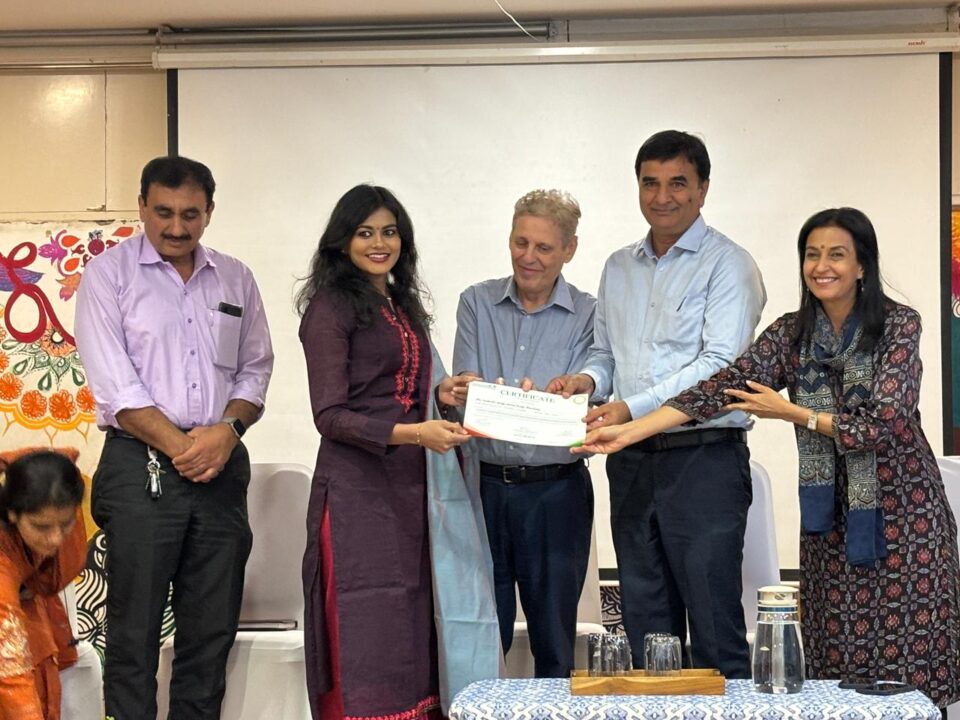
AHMEDABAD, GUJARAT | 08th APRIL 2026 — Marking a significant step towards transforming classroom practices, Mahatma Gandhi International School, through its Trust – International Education and Research Foundation (IERF), in association with Tata Trusts, successfully concluded its pedagogy-led Course Framework aligned with the National Education Policy (NEP) 2020. The programme culminated on April 8 with an interactive session followed by the distribution of certificates to participating teachers. This initiative focused on moving beyond traditional teaching methods towards a more practical, experience-based approach to learning. Instead of limiting teaching to textbooks, the framework enabled educators to understand how students learn through activities, projects, and real-life applications.
Three key learning courses with six modules—Making of a Healthy Vegetable Salad, Paper Plane, and Holistic Progress Card (HPC)—formed the core of the programme. These project-based models encouraged interdisciplinary learning, where a single activity helped students connect concepts across subjects, making classroom learning more engaging and meaningful.
The Holistic Progress Card (HPC) further supported continuous and competency-based assessment, focusing on the overall development of students rather than just academic scores. A total of 47 teachers were trained across six modules, with active participation and encouraging feedback received throughout the programme. Delivered through a digital platform, the course allowed teachers to learn at their own pace, supported by consistent academic and technical assistance from the MGIS faculties.
Anju Chazot, Founder of Mahatma Gandhi International School elaborated that this project is an initiative of the Ahmedabad Municipal Corporation. For many years we have followed a unique methodology where learning happens through activities and real-life projects. We believe that teacher training should also be conducted in the same way. This project, sponsored by Tata Trusts, was piloted with teachers from the Municipal Corporation School Board. We used AI to train teachers in the experiential learning approach emphasized in NEP 2020—something we have been practicing in our school for many years. The idea was to make learning joyful and engaging, so that children enjoy the process. Using everyday objects and real-life contexts, both students and teachers can stay interested and involved.
In this project, AI was used to ensure meaningful teacher engagement. It was not just about scrolling through content and completing a course. Teachers had to actively participate, provide feedback, and engage deeply. AI-based feedback, along with personalized feedback from our trainers, helped them truly understand how to create joyful learning experiences in the classroom and effectively implement NEP 2020.
Around 47 teachers from the Municipal School Board participated in the project, and we also received strong administrative support. Additionally, about 10 full-time teachers from our school (MGIS) were involved in creating the course content, designing the methodology, handling filming, and integrating AI.
Meenakshi Ganeriwala, Senior Manager Research & Development, Meenakshi Ganeriwala added, I have been associated with MGIs for the past 15 years.
Today’s training is the first of its kind, where an international school has partnered with AMC. As part of this initiative, 47 out of 50 AMC teachers are being trained—this is a pilot run. The training focuses on pedagogy and is delivered through a AI assisted platform, which includes various videos, question–answer modules, and other pedagogy-based resources.
This entire project is funded by Tata Trust. We have initially implemented it for 50 teachers, and the vision now is to expand it across Gujarat. The goal is to make Gujarat a state where all Government teachers are trained in pedagogy, enabling them to easily implement NEP 2020 in their schools.
The successful completion of the programme highlights a progressive shift towards making education more interactive, practical, and student-centric in line with NEP 2020.
